Showing posts with label Indian independence. Show all posts

Wednesday, 29 April 2020

Independence Question on Mohandas Karamchand Gandhi


Mohandas Karamchand Gandhi (2 October 1869 – 30 January 1948) was an Indian lawyer, anti-colonial nationalist, and political ethicist, who employed nonviolent resistance to lead the successful campaign for India's independence from British Rule, and in turn inspire movements for civil rights and freedom across the world. The honorific Mahātmā (Sanskrit: "great-souled", "venerable"), first applied to him in 1914 in South Africa, is now used throughout the world.

Born and raised in a Hindu family in coastal Gujarat, western India, Gandhi was trained in law at the Inner Temple, London, and called to the bar at age 22 in June 1891. After two uncertain years in India, where he was unable to start a successful law practice, he moved to South Africa in 1893 to represent an Indian merchant in a lawsuit. He went on to stay for 21 years. It was in South Africa that Gandhi raised a family, and first employed nonviolent resistance in a campaign for civil rights. In 1915, aged 45, he returned to India. He set about organising peasants, farmers, and urban labourers to protest against excessive land-tax and discrimination. Assuming leadership of the Indian National Congress in 1921, Gandhi led nationwide campaigns for easing poverty, expanding women's rights, building religious and ethnic amity, ending untouchability, and above all for achieving Swaraj or self-rule.
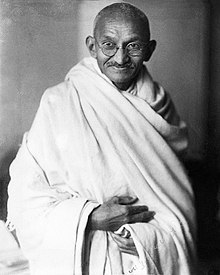


Independece Question on Mohandas Karamchand Gandhi 


 1.What is meant by the term 'Mahatma'?
 Answer: Great Soul


 2. What is the main implication of his philosophy?
 Answer: Means justify the ends

 3. What is the full name of the Mahatma?
 Answer: Mohandas Karamchand Gandhi


 4. What is the name of the Ashram that he set up?
 Answer: Sabarmati Ashram

  
 5. What did Gandhi’s family want him to become?
 Answer: Dewan (Prime Minister)


 6. Where did Gandhi go for his higher studies?
 Answer: London, England

  
 7. What was the organization that was contemporarily fighting for India’s freedom?
 Answer: Indian National Congress


 8. What was Gandhiji also called in Hindi which means Father?
 Answer: Bapu


 9. Where was Gandhiji born ?
 A) Porbander


 10.Which is a part of his ideals which he religiously followed ?
 A) Truth and Non-Violence

    
 11. What is the meaning of Satyagraha ?
 A) Force which is born of Truth

 12. What was Gandhiji's wife's name?
 A) Kasturba

Indian Independence

Indian Independence

A common story of all freedom fighters in chronological order.


App

Rebellion of 1857

10 May 1857 at Meerut | Mangal Pandey

The Indian Rebellion of 1857 is an another name of the "Indian Mutiny" where Indian soldiers working in British army refuse to obey the orders. Intersting fact is there were 3,00,000 Indian soldiers compare to 50,000 British troops. This was North India's First attempt to get Independence. It started on 10 May 1857 at Meerut when Mangal Pandey attacked British officer.

End of the East India Company, 1858

Empress of India - Queen Victoria

The Rebellion of 1857 was foundation of Indian Independence. British never imagined such a strong opposition from their own soldiers( offcourse Indian soldiers working under British Army). Although British Army suppressed the rebellions in June 1958, but still the Parliament of the United Kingdom removed the right of the British East India Company to rule India in November 1858. The United Kingdom decided to rule India directly through the Governor General (Viceroy). Thus, it included India as a part of the British Empire. Later, Queen Victoria used to call Empress of India. .

App

Formation of INC, December 1885

Founder of INC - A.O. Hume

British Empire came into existence after Rebellion of 1857. The Governor-General wanted to improve the governance of India with the participation of English-educated Indians. During same time, Retired British Indian Civil Service (ICS) officer Allan Octavian Hume (also known as A.O. Hume) thought to form a group of educated Indians to discuss civil and political situation of India in British Empire. Thus, on 28 December 1885, the Indian National Congress (INC) was founded at Gokuldas Tejpal Sanskrit College in Bombay, with 72 delegates in attendance..

Partition of Bengal, July 1905

Governor-General - Lord Curzon

Lord Curzon, the Viceroy and Governor-General of British Raj, ordered the partition of Bengal in July 1905. He justified the partition for improvements in administrative efficiency in the huge region covering Bengal, Bihar and Orissa. However, the Indians took partition as an attempt to disrupt the growing national movement in Bengal and divide the Hindus and Muslims of the region..

App

Arrival of Mahatma Gandhi, 1915

Gandhi, who?

Mahatma Gandhi studied from UCL Faculty of Law at London. After completing his studies, he went to South Africa to be the lawyer for Abdullah's cousin. He spent 21 years in South Africa. Gandhi returned to India on 9 January 1915. Gopal Krishna Gokhale became Gandhi's mentor.

Jallianwala Bagh Genocide, April 1919

Brigadier-General Reginald Dyer

After World War I, British tried to bring reforms in India in 1917. The positive impact of reform was seriously undermined in 1919 by the Rowlatt Act recommendation made by the Rowlatt Committee. The main purpose of Rowlatt Act was to analyse the war-time conspiracies by nationalist. It gave super powers to Viceroy like detaining political activists and arresting people without warrant. to oppose Rowlatt Act, a nationwide hartal (cessation of work) was called by activist. The agitation lead to Jallianwala Bagh massacre (or Amritsar Massacre) on 13 April 1919, in Amritsar, Punjab. The British military commander, Brigadier-General Reginald Dyer, blocked the main, and only entrance, and ordered his soldiers to fire into an unarmed and unsuspecting crowd of some 15,000 men, women, and children.

App

The Non-Cooperation Movement, 1920-1922

Swadeshi movement

The Non-Cooperation Movement was led by Mahatma Gandhi after the Jallianwala Bagh Massacre from 1 August 1920 to February 1922. The main objective was to resist British rule by non-violent (Ahinsa). People opted domestic products instead of British goods. The movement was withdrawn after Chauri Chaura incident where protesters clashed with police. Police opened the fire on protesters and in retaliation protesters set the fire in police station.

Purna Swaraj, 19 December 1929

Bhagat Singh and Indian National Congress

The Purna Swaraj (or declaration of the Independence of India) was announced by the Indian National Congress on 19 December 1929. Some sources suggest, Bhagat singh was the first person who gave call for Purna Swaraj (total Independence). This declaration made the Congress and Indian nationalists to fight for one mission that is Purna Swaraj (complete self-rule). Jawaharlal Nehru hoisted Indian flag on 31 December 1929 on the banks of Ravi river, in Lahore, Pakistan. the congress announced to celebrate Indian Independence on 26th January.

App

Azad hind Fauj, 1942

All India Forward Bloc

Subhas Chandra Bose was against India's involvement in World War I. He resigned from Congress due to differences in opinion with Gandhi. He created a separate group called Forward Bloc, later called All India Forward Bloc. British authorities placed Bose in house arrest but he escaped to his way through Afghanistan to Nazi Germany to seek Hitler and Mussolini's help for raising an army to fight the British. Hitler advised Bose to go to Japan. In Japan, Bose formed the Azad Hind Army with the help of Japan. Azad Hind Fauj (along with Japanese 15th Army) fought against British Army and captured Andaman and Nicobar islands. INA failed due to poor resources and surrendered to British Army. Bose escaped to Japanese-held Manchuria and thus, entire Azad Hind movement ended.

Quit India Movement, August 1942

Do or Die

Bharat Chhodo Andolan Bharat Chhodo Andolan (or Quit India Movement) was a civil disobedience movement. On 8 August 1942, the Quit India resolution was passed at the Mumbai session of the All India Congress Committee (AICC). Mahatma Gandhi gave a slogan "Do or Die !" for immediate self rule. Gandhi urged Indian's to leave their job's and join the movement. Congress led the movement and demanded the transfer of political power from British. The Quit India Movement turned out a failure and lasted till 1943.

App

Partition of India and Pakistan, June 1947

India got Independence on 15 August 1947 at 12:02 AM

Viscount Louis Mountbatten, the last British Governor-General of India, announced partition of British India into India and Pakistan on 2 June 1947. India celebrated the Independence on 15 August 1947 at 12:02 AM whereas Pakistan celebrated on 14 August. Jawaharlal Nehru became first Prime Minister. Sardar Vallabhbhai Patel became dupty prime minister who bought 565 princely states into Union of India. On June 1948, Chakravarti Rajagopalachari replaced Mountbatten as Governor General of India.

Top 100 GK Indian Independence Questions

Top 100 GK Indian Independence Questions

Indian Independence Questions and Answers in Chronological order


Rebellion of 1857
Question: When and where first North Indian struggle for independence occurred?
Answer: 10 May 1857 at Meerut
Question: What was the actual name of Rani Lakshmibai (Rani of Jhansi)?
Answer: Manikarnika
Question: What was the last battle in Rebellion of 1857?
Answer: Battle of Gwalior
Question: When was Rani Lakshmibai (Rani of Jhansi) killed?
Answer: June 1858
Question: After which struggle United Kingdom started ruling India directly through the Governor General?
Answer: Rebellion of 1857
Question: Who was the last emperor of the Mughal Empire in India?
Answer: Bahadur Shah II
Question: Mangal Pandey was sepoy (sipahi) of which regiment?
Answer: 34th Bengal Native Infantry (BNI) regiment
End of the East India Company, 1858
Question: Who was the first Governor-General of British India ?
Answer: Warren Hastings, the first Governor-General of British India from 1773 to 1785.
Question: Who was Empress of India in British rule?
Answer: Queen Victoria
Question: When Parliament of the United Kingdom withdrew the right of the British East India Company to rule India?
Answer: November 1858
Formation of INC, March 1885
Question: When was INC founded in India?
Answer: 28 December 1885
Question: Who founded INC?
Answer: A.O. Hume
Question: Who is known as "Grand Old Man of India" and "Unofficial Ambassador of India ?
Answer: Dadabhai Naoroji
Question: Who contested an election to the British House of Commons and became first Indian to be British MP?
Answer: Dadabhai Naoroji
Question: Who was among the first Indian nationalists to embrace swaraj as the destiny of the nation?
Answer: Bal Gangadhar Tilak
Question: When was All India Muslim League founded in India?
Answer: 30 December 1906, Dhaka, Bangladesh
Question: Who founded All India Muslim League?
Answer: Nawab Sir Khwaja Salimullah Bahadur
Question: Who was first General Secretary of INC?
Answer: A.O. Hume
Partition of Bangal, July 1905
Question: Who ordered the partition of the province of Bangal?
Answer: Lord Curzon
Question: When was Partition of Bangal announced?
Answer: July 1905
Question: What was the main objective of Swadeshi movement?
Answer: Boycotting British products
Revival of domestic products
Arrival of Mahatam Gandhi, 1915
Question: When did Gandhi returned to India after completing his education?
Answer: 9 January 1915
Question: Who was Gandhi's mentor in after he return to India?
Answer: Gopal Krishna Gokhale
Question: When was Mohandas Karamchand Gandhi born?
Answer: 2 October 1869 – 30 January 1948
Question: How many year Mahatma Gandhi Spent in south Africa?
Answer: 21 years
Question: When was Mohandas Karamchand Gandhi born?
Answer: 2 October 1869 – 30 January 1948
Question: When was Mohandas Karamchand Gandhi died?
Answer: 30 January 1948
Question: What was the name of Mahatma Gandhi's wife?
Answer: Kasturba Gandhi
Jallianwala Bagh Genocide, April 1919
Question: when did Rowlatt Act passed in Delhi?
Answer: 10 March 1919
Question: When did Jallianwala Bagh massacre happened?
Answer: 13 April 1919
Question: Who ordered soldiers to fire unarmed people at Jallianwala Bagh?
Answer: Brigadier-General Reginald Dyer
The Non-Cooperation Movement, 1920-1922
Question: Where did Chauri Chaura incident occurred?
Answer: Chauri Chaura in the Gorakhpur district
Question: When did Chauri Chaura incident happened?
Answer: 5 February 1922
Question: What was the duration of first non-co-operation movement?
Answer: 1920-1922
Question: What was the name of the newspaper established by Mahatama Gandhi?
Answer: Young India
Question: Who led first non-co-operation movement?
Answer: Mahatama Gandhi
Purna Swaraj, 19 December 1929
Question: When was Simon commission came to India ?
Answer: 1928
Question: How many British Members of Parliament were part of Simmon commission?
Answer: 7 members
Question: Who was the chairman of Simmon commission?
Answer: Sir John Simon
Question: When was Purna Swaraj was announced?
Answer: 19 December 1929
Question: Where did Jawaharlal Nehru first hoisted Indian flag?
Answer: Banks of Ravi river
Azad hind Fauj, 1942
Quit India Movement, August 1942


Thursday, 29 August 2019

Indian Independence

Indian Independence

A common story of all freedom fighters in chronological order.


App

Rebellion of 1857

10 May 1857 at Meerut | Mangal Pandey

The Indian Rebellion of 1857 is an another name of the "Indian Mutiny" where Indian soldiers working in British army refuse to obey the orders. Intersting fact is there were 3,00,000 Indian soldiers compare to 50,000 British troops. This was North India's First attempt to get Independence. It started on 10 May 1857 at Meerut when Mangal Pandey attacked British officer.

End of the East India Company, 1858

Empress of India - Queen Victoria

The Rebellion of 1857 was foundation of Indian Independence. British never imagined such a strong opposition from their own soldiers( offcourse Indian soldiers working under British Army). Although British Army suppressed the rebellions in June 1958, but still the Parliament of the United Kingdom removed the right of the British East India Company to rule India in November 1858. The United Kingdom decided to rule India directly through the Governor General (Viceroy). Thus, it included India as a part of the British Empire. Later, Queen Victoria used to call Empress of India. .

App

Formation of INC, December 1885

Founder of INC - A.O. Hume

British Empire came into existence after Rebellion of 1857. The Governor-General wanted to improve the governance of India with the participation of English-educated Indians. During same time, Retired British Indian Civil Service (ICS) officer Allan Octavian Hume (also known as A.O. Hume) thought to form a group of educated Indians to discuss civil and political situation of India in British Empire. Thus, on 28 December 1885, the Indian National Congress (INC) was founded at Gokuldas Tejpal Sanskrit College in Bombay, with 72 delegates in attendance..

Partition of Bengal, July 1905

Governor-General - Lord Curzon

Lord Curzon, the Viceroy and Governor-General of British Raj, ordered the partition of Bengal in July 1905. He justified the partition for improvements in administrative efficiency in the huge region covering Bengal, Bihar and Orissa. However, the Indians took partition as an attempt to disrupt the growing national movement in Bengal and divide the Hindus and Muslims of the region..

App

Arrival of Mahatma Gandhi, 1915

Gandhi, who?

Mahatma Gandhi studied from UCL Faculty of Law at London. After completing his studies, he went to South Africa to be the lawyer for Abdullah's cousin. He spent 21 years in South Africa. Gandhi returned to India on 9 January 1915. Gopal Krishna Gokhale became Gandhi's mentor.

Jallianwala Bagh Genocide, April 1919

Brigadier-General Reginald Dyer

After World War I, British tried to bring reforms in India in 1917. The positive impact of reform was seriously undermined in 1919 by the Rowlatt Act recommendation made by the Rowlatt Committee. The main purpose of Rowlatt Act was to analyse the war-time conspiracies by nationalist. It gave super powers to Viceroy like detaining political activists and arresting people without warrant. to oppose Rowlatt Act, a nationwide hartal (cessation of work) was called by activist. The agitation lead to Jallianwala Bagh massacre (or Amritsar Massacre) on 13 April 1919, in Amritsar, Punjab. The British military commander, Brigadier-General Reginald Dyer, blocked the main, and only entrance, and ordered his soldiers to fire into an unarmed and unsuspecting crowd of some 15,000 men, women, and children.

App

The Non-Cooperation Movement, 1920-1922

Swadeshi movement

The Non-Cooperation Movement was led by Mahatma Gandhi after the Jallianwala Bagh Massacre from 1 August 1920 to February 1922. The main objective was to resist British rule by non-violent (Ahinsa). People opted domestic products instead of British goods. The movement was withdrawn after Chauri Chaura incident where protesters clashed with police. Police opened the fire on protesters and in retaliation protesters set the fire in police station.

Purna Swaraj, 19 December 1929

Bhagat Singh and Indian National Congress

The Purna Swaraj (or declaration of the Independence of India) was announced by the Indian National Congress on 19 December 1929. Some sources suggest, Bhagat singh was the first person who gave call for Purna Swaraj (total Independence). This declaration made the Congress and Indian nationalists to fight for one mission that is Purna Swaraj (complete self-rule). Jawaharlal Nehru hoisted Indian flag on 31 December 1929 on the banks of Ravi river, in Lahore, Pakistan. the congress announced to celebrate Indian Independence on 26th January.

App

Azad hind Fauj, 1942

All India Forward Bloc

Subhas Chandra Bose was against India's involvement in World War I. He resigned from Congress due to differences in opinion with Gandhi. He created a separate group called Forward Bloc, later called All India Forward Bloc. British authorities placed Bose in house arrest but he escaped to his way through Afghanistan to Nazi Germany to seek Hitler and Mussolini's help for raising an army to fight the British. Hitler advised Bose to go to Japan. In Japan, Bose formed the Azad Hind Army with the help of Japan. Azad Hind Fauj (along with Japanese 15th Army) fought against British Army and captured Andaman and Nicobar islands. INA failed due to poor resources and surrendered to British Army. Bose escaped to Japanese-held Manchuria and thus, entire Azad Hind movement ended.

Quit India Movement, August 1942

Do or Die

Bharat Chhodo Andolan Bharat Chhodo Andolan (or Quit India Movement) was a civil disobedience movement. On 8 August 1942, the Quit India resolution was passed at the Mumbai session of the All India Congress Committee (AICC). Mahatma Gandhi gave a slogan "Do or Die !" for immediate self rule. Gandhi urged Indian's to leave their job's and join the movement. Congress led the movement and demanded the transfer of political power from British. The Quit India Movement turned out a failure and lasted till 1943.

App

Partition of India and Pakistan, June 1947

India got Independence on 15 August 1947 at 12:02 AM

Viscount Louis Mountbatten, the last British Governor-General of India, announced partition of British India into India and Pakistan on 2 June 1947. India celebrated the Independence on 15 August 1947 at 12:02 AM whereas Pakistan celebrated on 14 August. Jawaharlal Nehru became first Prime Minister. Sardar Vallabhbhai Patel became dupty prime minister who bought 565 princely states into Union of India. On June 1948, Chakravarti Rajagopalachari replaced Mountbatten as Governor General of India.

Friday, 23 August 2019

Indian Independence - Rebellion of 1857


Top 100 GK Indian Independence Questions

Top 100 GK Indian Independence Questions

Indian Independence Questions and Answers in Chronological order


Rebellion of 1857
Question: When and where first North Indian struggle for independence occurred?
Answer: 10 May 1857 at Meerut
Question: What was the actual name of Rani Lakshmibai (Rani of Jhansi)?
Answer: Manikarnika
Question: What was the last battle in Rebellion of 1857?
Answer: Battle of Gwalior
Question: When was Rani Lakshmibai (Rani of Jhansi) killed?
Answer: June 1858
Question: After which struggle United Kingdom started ruling India directly through the Governor General?
Answer: Rebellion of 1857
Question: Who was the last emperor of the Mughal Empire in India?
Answer: Bahadur Shah II
Question: Mangal Pandey was sepoy (sipahi) of which regiment?
Answer: 34th Bengal Native Infantry (BNI) regiment
End of the East India Company, 1858
Question: Who was the first Governor-General of British India ?
Answer: Warren Hastings, the first Governor-General of British India from 1773 to 1785.
Question: Who was Empress of India in British rule?
Answer: Queen Victoria
Question: When Parliament of the United Kingdom withdrew the right of the British East India Company to rule India?
Answer: November 1858
Formation of INC, March 1885
Question: When was INC founded in India?
Answer: 28 December 1885
Question: Who founded INC?
Answer: A.O. Hume
Question: Who is known as "Grand Old Man of India" and "Unofficial Ambassador of India ?
Answer: Dadabhai Naoroji
Question: Who contested an election to the British House of Commons and became first Indian to be British MP?
Answer: Dadabhai Naoroji
Question: Who was among the first Indian nationalists to embrace swaraj as the destiny of the nation?
Answer: Bal Gangadhar Tilak
Question: When was All India Muslim League founded in India?
Answer: 30 December 1906, Dhaka, Bangladesh
Question: Who founded All India Muslim League?
Answer: Nawab Sir Khwaja Salimullah Bahadur
Question: Who was first General Secretary of INC?
Answer: A.O. Hume
Partition of Bangal, July 1905
Question: Who ordered the partition of the province of Bangal?
Answer: Lord Curzon
Question: When was Partition of Bangal announced?
Answer: July 1905
Question: What was the main objective of Swadeshi movement?
Answer: Boycotting British products
Revival of domestic products
Arrival of Mahatam Gandhi, 1915
Question: When did Gandhi returned to India after completing his education?
Answer: 9 January 1915
Question: Who was Gandhi's mentor in after he return to India?
Answer: Gopal Krishna Gokhale
Question: When was Mohandas Karamchand Gandhi born?
Answer: 2 October 1869 – 30 January 1948
Question: How many year Mahatma Gandhi Spent in south Africa?
Answer: 21 years
Question: When was Mohandas Karamchand Gandhi born?
Answer: 2 October 1869 – 30 January 1948
Question: When was Mohandas Karamchand Gandhi died?
Answer: 30 January 1948
Question: What was the name of Mahatma Gandhi's wife?
Answer: Kasturba Gandhi
Jallianwala Bagh Genocide, April 1919
Question: when did Rowlatt Act passed in Delhi?
Answer: 10 March 1919
Question: When did Jallianwala Bagh massacre happened?
Answer: 13 April 1919
Question: Who ordered soldiers to fire unarmed people at Jallianwala Bagh?
Answer: Brigadier-General Reginald Dyer
The Non-Cooperation Movement, 1920-1922
Question: Where did Chauri Chaura incident occurred?
Answer: Chauri Chaura in the Gorakhpur district
Question: When did Chauri Chaura incident happened?
Answer: 5 February 1922
Question: What was the duration of first non-co-operation movement?
Answer: 1920-1922
Question: What was the name of the newspaper established by Mahatama Gandhi?
Answer: Young India
Question: Who led first non-co-operation movement?
Answer: Mahatama Gandhi
Purna Swaraj, 19 December 1929
Question: When was Simon commission came to India ?
Answer: 1928
Question: How many British Members of Parliament were part of Simmon commission?
Answer: 7 members
Question: Who was the chairman of Simmon commission?
Answer: Sir John Simon
Question: When was Purna Swaraj was announced?
Answer: 19 December 1929
Question: Where did Jawaharlal Nehru first hoisted Indian flag?
Answer: Banks of Ravi river
Azad hind Fauj, 1942
Quit India Movement, August 1942


Indian Independence Quiz Collection

Indian Independence Quiz Collection

Every quiz is customized for you


You may be interested in ...


Quiz on Current Affairs


Indian Independence - Partition of Bengal


Indian Independence - Formation of INC


Indian Independence - End of the East India


Indian Independence - The Non-Cooperation Movement